

Breaking Down The Start: Why The First Second Matters
At the beginning of each race, they stand on the block and wait for the official to tell them to “take their mark”, then get in the starting position and wait for the buzzer to go off.
Liz VandWedge, the head coach of the hamilton boys swim and dive team said “The first seconds of a race are the most important since that is when swimmers are the most powerful and explosive.
They plunge into the water, hearts racing as the piercing signal sounds. The cold hits their body as a rush of adrenaline soars through them while they rip through the water; they don’t stop for a second.
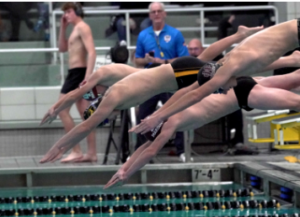
Liz states that “Their push off the block is translated into a tight bodyline in the air to make a perfect entry into the water created by the hands that the rest of their body must follow through. The speed carries through the water while swimmers continue the speed with their underwater dolphin kicks into their first stroke. If swimmers have a bad start or entry into the water, valuable seconds can be lost.”
Swimmers need a really good reaction time at the start of the race because every second wasted can cost them. The breaststroke relies on timing, rhythm, and coordination.
It is one of the main swim strokes that is recurrent; it’s a constant “pull, breathe, kick, glide.” The timing between the arm pull and the kick is crucial for maintaining momentum.
Zack Bain, a swimmer on the team, states that “Every second matters because you have to do everything as perfectly as possible. I need to do a perfect pullout, I need to have the perfect glide on each stroke, kick just the right way, and have extremely well-timed turns. Especially while I’m racing, I am constantly thinking about how many strokes I take into each wall, and how efficient my pull and hook are.”
If there’s even a slip in the first second, it can cause the swimmer to fall behind.
Every swimmer tries to be the first to dive into the water and immediately start to swim, but it’s not just about who dives into the water first its also about who pulls first, who breathes first, who kicks first, and who glides first.